How to build API security into your CI/CD pipeline: A DevSecOps playbook
Zoran Gorgiev, Gavin Sutton
Table of contents

63% of organizations have integrated API security into their CI/CD pipelines, but only 12% run a security scan on every code commit (Cheenepalli et al., 2025).
In other words, most teams have included API security in CI/CD pipelines. But too many have left substantial gaps in how they applied it. This article analyzes what those gaps look like in practice and explains how to close them stage by stage.
Why the CI/CD pipeline is the right place to start
Every deployment carries risk. New exposed endpoints, changes to authentication logic, and sensitive data flowing through updated routes can occur without the security team ever knowing.
The CI/CD pipeline is where code becomes production software. It is also where security checks have the most influence: catching a vulnerability before deployment costs a fraction of what it costs to fix it in production.

Shift-left security is not a new idea. But applying it specifically to API security testing, systematically at every pipeline stage, is something most organizations have not done well yet.
67% of small and medium-sized enterprises report that DevSecOps practices are highly effective at improving their security postures. Still, in most organizations, security scans run weekly (37%) or daily (24%), instead of on every commit (Cheenepalli et al., 2025). This mismatch — believing in the practice while under-applying it — is precisely where gaps develop.
Four pillars of API security in CI/CD
Saleh et al. (2025) reviewed **34 studies on API security in CI/CD pipelines **and identified four core defensive strategies.
Access control
Every component in the pipeline — CI runners, service accounts, API gateways, and deployment targets — needs a clearly scoped identity with only the permissions it actually needs. Over-permissioned GitHub Actions workflows and misconfigured IAM roles in cloud runners are among the most common weaknesses.
Secrets management
API keys, tokens, and passwords should never appear in YAML files, pipeline scripts, or environment variables exposed to third-party actions. Tools like HashiCorp Vault, AWS Secrets Manager, and GitHub’s encrypted secrets keep credentials out of pipeline code by injecting them at runtime instead.
However, a missing vault is rarely the main problem. It is usually what leaks around it, such as credentials committed to a repository, printed in a CI log, or handed to a machine identity that doesn’t need them.
Policy enforcement
Policy-as-Code tools such as Open Policy Agent, Checkov, and Kyverno scan pipeline configurations and infrastructure definitions before any deployment. They’re the practical mechanism for catching insecure YAML patterns, exposed tokens, and weak authentication checks early, before they become a production problem.
Runtime observability
Everything above happens before or during deployment. But once an API is live, you still need to know what it’s doing. Information on which calls are being made, whether authentication behaves as expected, and whether traffic looks normal is key.
Most pipelines invest heavily in build-time checks and almost nothing in post-deployment monitoring. That’s where token replay, privilege misuse, and lateral movement tend to go unnoticed.
A Stage-by-stage playbook
Each stage of the CI/CD pipeline requires specific security controls, applied at the right time.
Pre-commit and code review
Static application security testing (SAST), such as the one offered by Checkmarx, is extremely important to run as early as possible. Code checks can catch hardcoded API keys, insecure patterns, and known vulnerability signatures before these enter the repository.
Next, scan secrets on every commit. It helps you detect accidental credential exposure early. Sensitive data in source code remains one of the most preventable security risks in software development.
In addition, include OpenAPI specification linting to check whether your API contract is valid and consistent. That way, you maintain quality and alignment. But keep in mind that this is a correctness check, not a proper security control.
Finally, define and review auth models early, as security should start at design time:
- Validate OAuth2/OIDC implementations.
- Apply least-privilege access principles.
- Implement token scoping.
Good early decisions prevent entire classes of vulnerabilities before developers even write the first line of code.
Build stage
Make use of software composition analysis (SCA) to check third-party libraries against known vulnerability databases. Generate a Software Bill of Materials (SBOM), such as a CycloneDX SBOM, to improve visibility and traceability of dependencies. And add container image scanning to catch vulnerable base images before they are packaged.
Scanning Infrastructure-as-Code (IaC) configurations also helps, particularly to detect:
- Misconfigured IAM roles
- Publicly exposed storage
- Overly permissive access controls
Those three are common sources of breaches, so you should treat them as primary security risks.
If you use an OpenAPI specification, check whether the schema is correct and how well it aligns with the actual API implementation. But consider that these checks only allow you to verify that the API behaves in line with its definition — they do not guarantee security.
At this stage, you can run Equixly against preview or ephemeral environments (requires a running service) to assess API behavior as early in the pipeline as possible.
Test and staging
Traditional DAST tools execute predefined attack patterns against individual endpoints. That is useful, but it often misses vulnerabilities that emerge across multi-step workflows. One such example is the most critical API security risk, Broken Object Level Authorization (BOLA), which often requires actions across multiple users and requests.
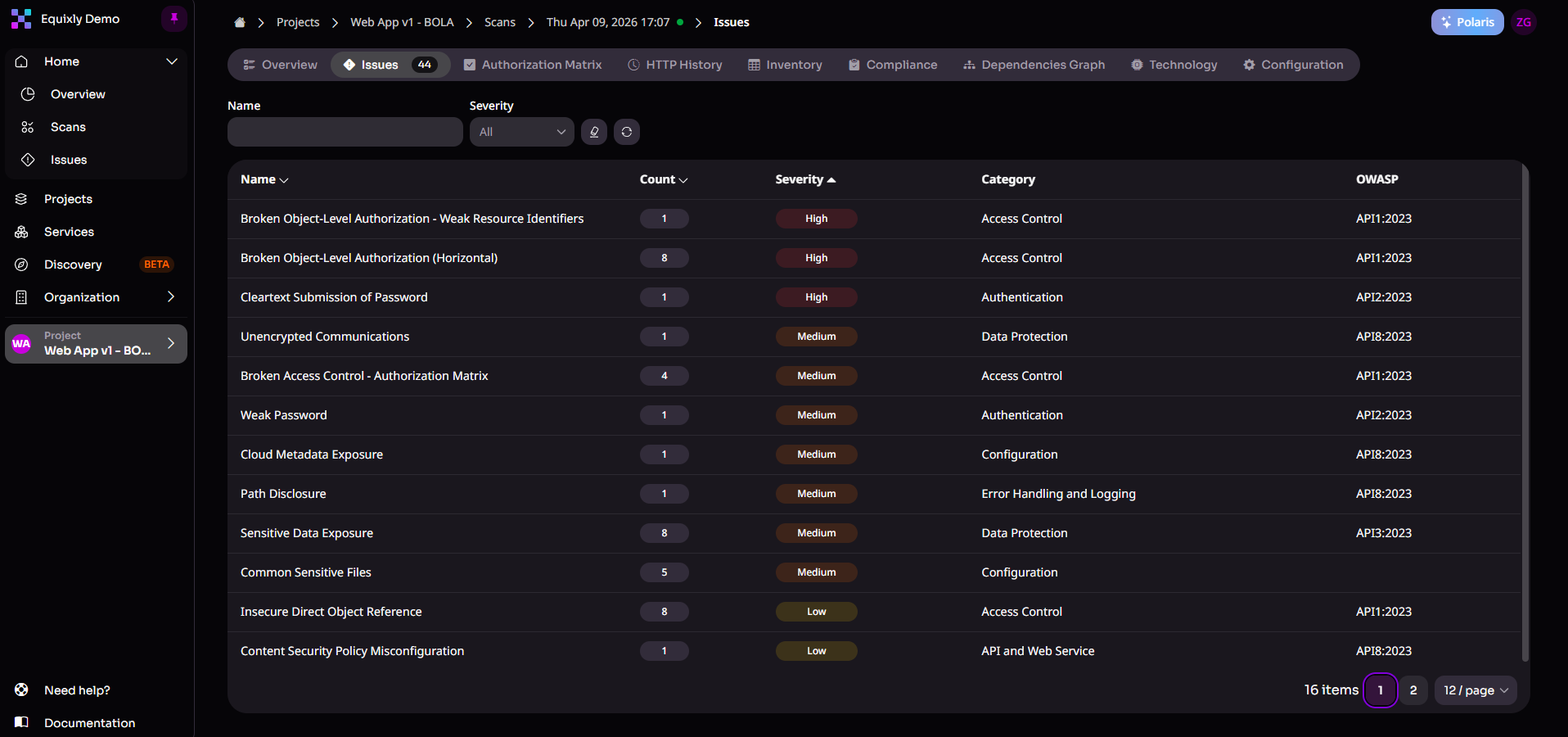
Equixly is developed to address this gap in DAST. It dynamically maps the API, learns its behavior, and generates stateful attack sequences adapted to your endpoints and authentication flows. This purpose-built approach makes it possible to successfully test for all the OWASP API Security Top 10.
Since it operates on a running application, Equixly evaluates how the API behaves in the wild. That includes discovering undocumented (shadow) and deprecated (zombie) APIs that are not present in your OpenAPI specification, which is key to thorough visibility.
Equixly integrates naturally into staging environments and can run continuously, not only as a one-time scan. This capability makes it possible for teams to detect vulnerabilities introduced by new releases and always validate API behavior before deployment.
Deployment gates
Do not block on every issue, but define gating policies based on risk:
- Block deployments only on critical and high-severity findings.
- Track and remediate lower-severity issues without stopping delivery.
You should apply these principles to all pipeline checks:
- SAST
- SCA and SBOM analysis
- Secrets scanning
- IaC scanning
- API security testing
It is worth noting that findings from Equixly can feed directly into these gates, particularly for high-impact issues such as authorization flaws or exploitable multi-step attack paths.
Another important thing to note is that you should inject credentials at runtime from a secure vault rather than embedding them in code or configuration. No hardcoded secret should reach production.
Post-deployment monitoring
Production monitoring closes the loop and is often the most overlooked stage.
To address this problem, set up API-centric telemetry to track:
- Authentication and authorization events
- Anomalous API usage patterns
- Unexpected request sequences
- Traffic spikes and abuse patterns
It’s equally important to integrate the data into your incident response workflows.
Runtime protection must also include:
- Rate limiting
- Bot detection
- Abuse prevention mechanisms
These controls address attack patterns that are not always captured during pre-deployment testing.
You can deploy Equixly to production to change API security from periodic testing to continuous validation. It will:
- Retest APIs after each release.
- Detect newly exposed or changed endpoints.
- Validate authentication and authorization flows in real-world conditions.
Closing the loop
An effective API security program is continuous. Instead of test → deploy → forget, it operates as test → deploy → continuously validate → feed findings back into development.
Equixly is invaluable in that respect, since it validates how your APIs behave in different workflows, roles, and states. Thus, in addition to its role in the testing phase, it can complement other controls — SAST, SCA, secrets scanning, and IaC security — at virtually every stage of the CI/CD pipeline. As a result, you get coverage that spans both known vulnerability patterns and complex, real-world API behaviors.

Final thoughts
API security in CI/CD is a set of deliberate decisions. Made early, executed consistently, and validated continuously, they make it very hard for a vulnerability to survive from commit to production.
In DevSecOps, security is the sum of everything the pipeline does. When each stage does its job, security keeps pace with delivery — and teams spend less time fighting incidents in production and more time shipping.
See how Equixly fits into your pipeline — book a demo!
FAQs
Can API security testing be fully automated in CI/CD pipelines?
Yes, but only if you use purpose-built API security tools. Generic vulnerability scanners — originally built for web apps — test endpoints in isolation, missing logic flaws that only appear in multi-step workflows.
How does automated API security testing affect deployment speed?
It depends on the tools and how thorough and systematic they are. Static checks typically run fast. Dynamic API security testing takes longer but runs in parallel with other pipeline stages. All things considered, the overhead is far smaller than the cost of fixing a vulnerability in production.
How does continuous API security testing differ from a traditional penetration test?
A period penetration test is a snapshot; it reflects your security posture on the day it was run. Every release after that introduces changes the test never saw. Continuous API security testing runs against every deployment, so findings always reflect the API’s current state.

Zoran Gorgiev
Technical Content Specialist
Zoran is a technical content specialist with SEO mastery and practical cybersecurity and web technologies knowledge. He has rich international experience in content and product marketing, helping both small companies and large corporations implement effective content strategies and attain their marketing objectives. He applies his philosophical background to his writing to create intellectually stimulating content. Zoran is an avid learner who believes in continuous learning and never-ending skill polishing.

Gavin Sutton
Head of Marketing
Gavin is marketing leader with more than a decade of experience in the cybersecurity industry helping startups and scale ups grow internationally. He has a passion for working with disruptive technology companies who can reshape the security landscape with their innovative solutions.