Is agentic AI changing the DAST vs. penetration testing discussion?
Zoran Gorgiev, Gavin Sutton
Table of contents

London, UK. A security engineer at a fintech company opens her dashboard on an unusually sunny Tuesday morning. The DAST scans from last night are green. The penetration test report from three months ago sits in a shared folder. Seventeen pages of findings — all remediated, all closed. Her organization’s APIs serve millions of transactions a day. By every metric, her company is doing a good job.
It is also, without her knowing it, vulnerable.
The DAST tool scanned every endpoint last night. It sent payloads, checked responses, and matched patterns. It found nothing it was not looking for.
The penetration testers, three months ago, probed intelligently and deeply. For two weeks, across a defined scope, against the API surface as it was then. They found genuine security risks, and the dev team fixed them. But since that test, developers have deployed eleven times. New endpoints, new authorization paths, new sequences of API calls that no one has tested with adversarial intent.
The lurking security vulnerability is not exotic. An attacker authenticates as a standard user, requests their own account data, changes one digit in the object ID, and reads someone else’s information. The server never checks whether the authenticated user owns the resource they are requesting.
It is Broken Object Level Authorization (BOLA), the stubbornly most severe vulnerability in the OWASP API Security Top 10. No malicious string. No injection payload. Just a legitimate-looking request for the wrong object.
The DAST tool will never find it. Not because it is poorly built, but because finding BOLA requires understanding what the object ID means inside this specific application’s authorization model. And that is not something a scanner does.
The penetration testers would have found it if they tested the right endpoint, in the right sequence, with the right user context, in the current version of the API. But they are not here. They were three months ago.
This is the gap the DAST vs. penetration testing discussion has circled for years without closing. And it is the gap that agentic AI is now, for the first time, capable of closing — continuously, on every deployment, without waiting for a quarterly engagement or hoping the scanner fires the right payload.
To understand why this matters, you need to understand what each approach actually does and where each one structurally fails.
What DAST does, and what it cannot do
Dynamic application security testing probes a running application from the outside, without access to source code. A DAST scanner sends HTTP requests to a live target, reads the responses, and checks them against a library of known vulnerability patterns, such as:
- SQL injection payloads
- Cross-site scripting strings
- Missing security headers
- Weak authentication tokens
It is a black-box testing approach that sees the application as an attacker would.
DAST can:
- Find known vulnerabilities in deployed systems.
- Integrate into CI/CD pipelines.
- Run without a security engineer managing every scan.
- Produce consistent results.
Unlike static application security testing (SAST), which analyzes source code before the application runs, DAST detects runtime vulnerabilities — misconfigurations, authentication failures, and injection points that only appear when the application is running. And for compliance purposes — PCI DSS, for instance — it delivers documented evidence of security testing.
However, DAST has a fundamental limitation that no amount of engineering can fully overcome: it tests endpoints against patterns it already knows, without understanding what those endpoints mean to each other.
For instance, a scanner sends a payload to /api/accounts/123 and inspects the response. It does not ask whether that endpoint is meaningful only after a valid POST /auth/login, whether the login token constrains which accounts the user can see, or whether the same object ID in a different endpoint unlocks an entirely different resource.
Even modern DAST tools that handle authentication flows, executing a login sequence to reach protected endpoints, do so mechanically. They do not have the capacity to reason about what chaining those endpoints means for business logic. In other words, a DAST scanner only executes the sequence; it does not model it.
This is not a technology gap that better engineering will close. It is a consequence of what DAST is: a system that finds dangerous data and patterns. It cannot find dangerous intent, manifested in authorization bypasses, business rule violations, and multi-step attack chains. That’s because those scenarios require understanding how the application is supposed to behave before you can see where it breaks.
Traditional vs. modern DAST

Traditional DAST tools built on engines like OWASP ZAP — released in 2010 for web applications with forms, pages, and crawlable links — carry these limitations deep in their architecture. Vendors adapted them to APIs over time, but no one rebuilt the core engine for API-specific attack patterns.
Equixly ran several of these engines against the same intentionally vulnerable API and found that they detected zero high-severity logic vulnerabilities. Conversely, Equixly identified all of them and found 80% more security issues overall. The gap is architectural: these engines look for dangerous data, not dangerous actions.
StackHawk, Bright Security, Invicti, and other modern DAST tools have genuinely addressed many legacy shortcomings. They
- Consume OpenAPI and Swagger specifications natively.
- Handle OAuth2 and JWT authentication.
- Slot into CI/CD pipelines from the start.
- Use AI to reduce false positives.
These are genuine improvements. A 2025 empirical study that tested 9 SAST and DAST solutions across 75 real-world web applications found that DAST tools outperformed SAST tools in detecting broken access controls, insecure design, and vulnerable and outdated components (Qadir et al., 2025). Modern DAST is not ZAP-era scanning.
However, even modern DAST tools test against predefined vulnerability patterns. They identify what their rule sets define as dangerous. They do not reason about whether a legitimate-looking sequence of API calls could result in a breach that no single request would reveal.
Independent assessments of leading tools in this space consistently find that coverage of business logic flaws remains limited across the category (Albahar et al., 2022). And that is exactly where the most severe and commonly exploited API vulnerabilities live.
What penetration testing does, and what it cannot do
Penetration testers approach an application as an authorized adversary. They map the attack surface, study the application’s logic and workflows, form hypotheses about what might break, and test those hypotheses.
Unlike a scanner, a pentester understands that a finding in endpoint A might unlock something in endpoint B. They chain observations. They notice that a Viewer role can trigger a Delete operation by manipulating the API flow. They try something, watch what happens, and decide what to try next.
That capacity to reason about sequences and intent is what makes penetration testing necessary for business logic flaws. Research confirms it directly.
An empirical study at the National College of Ireland tested a web application with both automated DAST tools and manual penetration testing. The DAST tool caught SQL injection and cleartext password transmission. Manual pentesting found every business logic flaw, including:
- Excessive client-side trust that allowed an attacker to tamper with purchase quantities via a proxy
- Failure to reject nonsensical inputs, such as negative prices
- Broken access controls that let a regular user’s session cookie open the admin panel
The automated tools missed every one of those.
The security engineer on that Tuesday morning needs what penetration testers provide. The problem is that she cannot have it continuously, and she cannot afford it at the scale her API surface now demands.
Equixly’s research found that an expert pentester needs roughly 154 hours to test only 40% of an API with 40 endpoints, which is **more than 6 full working days **to cover less than half of a single API’s endpoints. And a typical enterprise runs hundreds of APIs.
Manual API penetration testing can cost $25,000 per application for a single point-in-time assessment. But this security assessment becomes outdated even before the report reaches the team. When developers deploy weekly or daily, a penetration test from three months ago describes an attack surface that no longer exists.

The gap that neither DAST nor traditional pentesting fills
DAST and traditional penetration testing grew out of a slower world, in which applications had clear perimeters, shipped on predictable schedules, and a security team could act as a release checkpoint. But that world is gone. And APIs are why.
In modern systems — web applications, mobile apps, IoT devices, payment gateways, AI infrastructure, cloud services, and inter-organizational integrations — APIs enforce identity, control authorization, and execute business logic. Load a dashboard, and your browser makes dozens of calls to different backend services before the page fully renders.
Each endpoint offers a possible entry point into your application’s core logic. And every new deployment potentially opens an access path that nobody continuously tests with a deliberately “malicious” intent.
BOLA, Broken Function Level Authorization (BFLA), Broken Object Property Level Authorization (BOPLA), and business logic flaws thrive in this environment precisely because finding them requires understanding how the application is supposed to work before you can see where it fails. No scanner comparing payloads against signatures will ever find them. No human pentester running quarterly engagements will keep pace with constant deployment.
The security engineer with green dashboards and a clean pentest report from three months ago lives inside this gap. So does most of the industry.
What agentic AI changes
On a different Tuesday, Equixly was running routine security testing on an AI framework. It mapped the API surface, identified an unauthenticated endpoint that accepted binary data, sent a request, and read the error response: UnpicklingError: invalid load key.
That single error message told Equixly what it needed to know: the endpoint was deserializing pickle data. Equixly’s agentic AI connected that behavior to a known remote code execution path in cloudpickle, crafted a proof-of-concept payload, and confirmed exploitation.
The discovery resulted in CVE-2026-0773, with a CVSS score of 9.8. A critical zero-day vulnerability hiding in infrastructure that AI companies rely on to serve their models. No signature existed for it. No documented pattern covered it. No predefined rule could have flagged it.
Equixly’s agentic AI reasoned its way to it from first principles, the same way a skilled human researcher would. And it did so as part of its routine security testing on an application considered secure.
This discovery was not a lucky hit. It required the same sequence of steps a skilled human researcher follows: map the surface, understand the behavior, reason about the implications, and construct the exploit.
The difference is that the agent did it autonomously, without anyone scheduling it or scoping it in advance. That combination, human-like reasoning at machine scale and cadence, is what **Equixly’s Agentic AI Hacker **was purpose-built to deliver.
Equixly takes the best of both worlds, DAST and traditional penetration testing, but does not stop there.
Like a DAST tool, it tests live, running applications from the outside without access to source code. It integrates into CI/CD pipelines, triggers on every code commit, and produces consistent, repeatable results without a security engineer managing each scan.
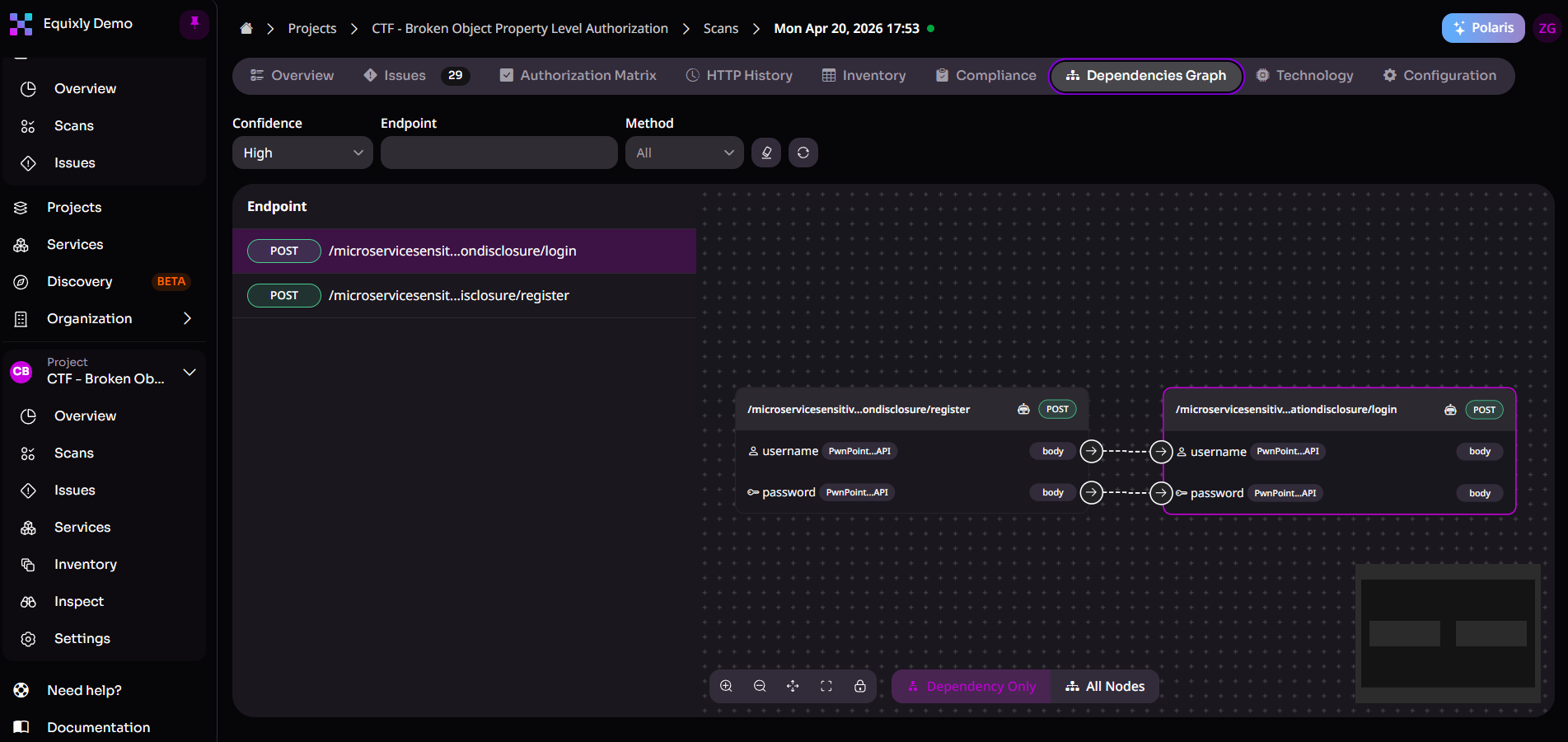
Like a human pentester, the Agentic AI Hacker reasons about the application. It builds a model of how the application works — mapping endpoints, authentication flows, data dependencies, and state transitions — before it attacks anything.
It sequences requests because it understands that endpoint B may only be exploitable after a specific interaction with endpoint A. It chains findings into multi-step attack paths and targets logic flaws instead of just dangerous payloads.
And here is where it surpasses both: Equixly finds vulnerabilities that DAST scanners cannot find, and does so at a scale and cadence that human pentesters cannot match. More specifically, Equixly’s Agentic AI Hacker:
- Discovers thoroughly the API attack surface, including undocumented endpoints. Equixly ingests OpenAPI and Swagger specifications, interacts with your APIs, and infers hidden and shadow endpoints and parameters by reasoning from naming patterns, response structures, and observed behavior.
- Builds a model of the application’s logic before attacking it. Equixly maps data relationships, authentication protocols, transactional flows, and expected state transitions. It understands what each API call means within the application’s workflow — a prerequisite for finding logic flaws that no scanner can detect.
- Generates and executes multi-step attack chains. Equixly acquires a session token, finds a parameter validation weakness in one microservice, and executes a BOLA attack against a downstream service. And it does so all within a single workflow. No predefined sequence guides this. The agent constructs it based on what it learns.
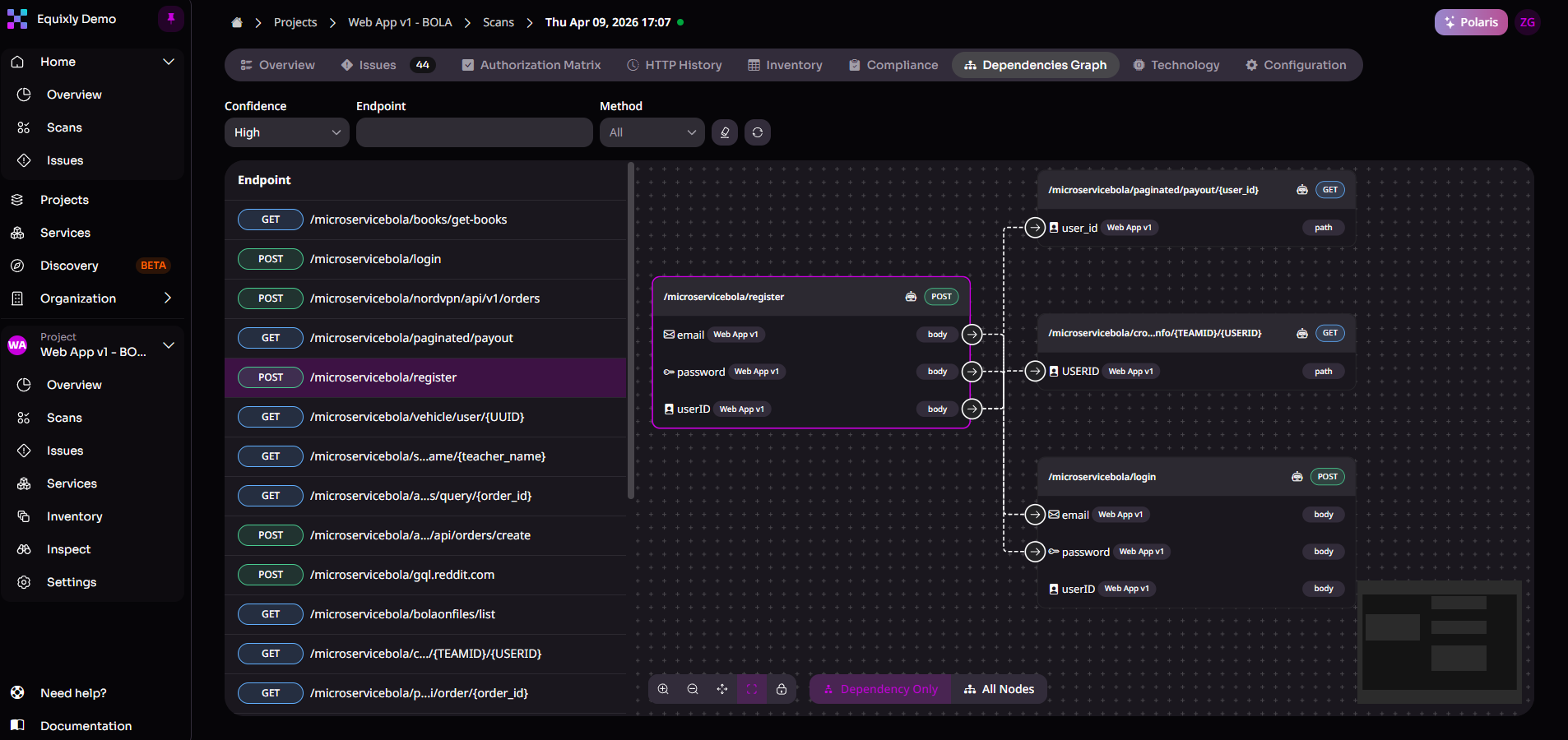
- Covers the full OWASP API Security Top 10. Equixly validates BOLA, BFLA, broken authentication, insufficient rate limiting, and all the other security risks from the OWASP API Security Top 10 project with proofs of concept. It does not simply report potential vulnerabilities. It delivers the exact sequence of requests that confirm exploitability, with timestamps, parameters, and observed responses.
- Extends to AI and LLM applications through its GenAI security suite. As organizations deploy LLM-powered systems exposed via APIs, Equixly tests for the vulnerabilities that make those systems dangerous: prompt injection, excessive agency, insecure output handling, misinformation, among others, aligned with the OWASP Top 10 for GenAI.
- Provides ongoing compliance evidence. Every scan maps findings against ASVS, OWASP Top 10 API, and PCI DSS. That way, security and compliance teams get a record of their security posture across deployments.
Equixly’s approach supports a security posture that reflects your application’s current state, so you don’t have to deal with the risk gaps left by point-in-time pentesting and the limitations of DAST’s predefined vulnerability categories.
Remember the security engineer in London? Equixly would have found the untested BOLA vulnerability lurking in her organization’s application on the very deployment that introduced it.
Where does this leave DAST vs. penetration testing?
This framing is becoming less useful as a decision-making tool. It is not because either approach has disappeared, but because the question it tries to answer has changed.
DAST asked: Does this application exhibit any known vulnerability patterns we can detect?
Penetration testing asked: Can a motivated attacker find a way to break something meaningful?
Security programs needed them both because neither answered the other’s question.
Agentic AI, as embodied in Equixly’s Agentic AI Hacker, answers both. It finds known vulnerability patterns at scale and continuously. It reasons about application logic and chains findings into realistic attack paths. It runs on every deployment instead of periodically, after the fact.
So, what has changed is the baseline. The security assurance that previously required a skilled pentester working for days is now something development and security teams can get continuously, on every build. That is a different world from the one where “DAST or pentesting” was a good question.
However, consider that the human in the loop remains as important as ever. Curtis & Eisty (2025) explored 58 peer-reviewed studies on AI-assisted pentesting. They found that AI works most effectively when it operates alongside humans instead of in their place.
The security engineer in London will open her dashboard again tomorrow morning. The scans will be green. Somewhere in last night’s deployment, an authorization path nobody documented is waiting for someone to find it first.
Your next deployment could introduce the vulnerability your last pentest never saw.
Book a demo to see what Equixly finds in your APIs.
FAQs
Does DAST replace penetration testing for API security?
DAST can find known vulnerability patterns, but it cannot reason about business logic, object relationships, or multi-step attack chains. You need penetration testing for that. Historically, mature security programs have used both.
What makes agentic API security testing different from an AI-enhanced DAST tool?
An AI-enhanced DAST tool uses AI to improve scanning through smarter payloads, lower false-positive rates, and better crawling. An agentic system builds a model of the application, sequences its testing based on what it learns, and adapts based on results, the way a pentester does. This way, it can find security vulnerabilities that no predefined pattern library would identify.
How often should APIs receive security testing?
Every time they change, which, in modern CI/CD environments, means continuously. Dev teams update APIs weekly or daily. Consequently, application programming interfaces need to be tested at the same cadence. A quarterly or annual penetration test captures only one point in time, and that point grows increasingly outdated with every deployment.

Zoran Gorgiev
Technical Content Specialist
Zoran is a technical content specialist with SEO mastery and practical cybersecurity and web technologies knowledge. He has rich international experience in content and product marketing, helping both small companies and large corporations implement effective content strategies and attain their marketing objectives. He applies his philosophical background to his writing to create intellectually stimulating content. Zoran is an avid learner who believes in continuous learning and never-ending skill polishing.

Gavin Sutton
Head of Marketing
Gavin is marketing leader with more than a decade of experience in the cybersecurity industry helping startups and scale ups grow internationally. He has a passion for working with disruptive technology companies who can reshape the security landscape with their innovative solutions.