Penetration testing vs. vulnerability scanning
Zoran Gorgiev, Gavin Sutton
Table of contents
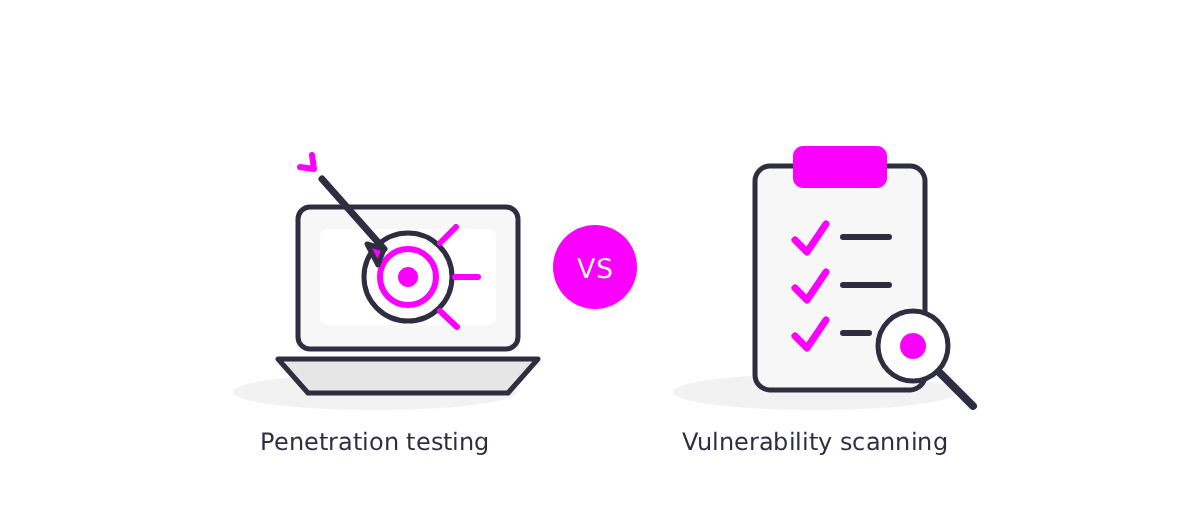
Many security breaches have happened because of a known vulnerability. That, at face value, doesn’t come as much of a surprise, does it?
However in reality, that’s counterintuitive. A vulnerability was known, and we mean not just publicly known but flagged by the organization’s vulnerability scanner, and added to a backlog. Still, a breach occurred.
Clearly, something’s missing here, and something important. You might have thought, duh, patching or mitigation. And you’d be right. But that’s not all.
Before patching or mitigating, you must know what’s genuinely exploitable, its business impact, the evidence for it, and where it sits on a list of priorities among gazillions of other threat exposures. And that’s where penetration testing comes into play.
The pen testing vs. scanning debate has a clear answer. For instance, compliance requirements clearly differentiate between the two. PCI DSS v4.0.1 treats vulnerability scanning (Requirement 11.3) and penetration testing (Requirement 11.4) as separate obligations, with different cadences and different evidence requirements.
Yet, organizations often confuse the two. The problem is that this conceptual confusion can have extremely tangible practical consequences. Accordingly, it takes a clear understanding of both to:
- Assess risk accurately
- Allocate resources effectively
- Avoid mistaking visibility for assurance
What is the difference between penetration testing and vulnerability scanning?
Both practices look for weaknesses, but that’s roughly where the similarity ends. They differ in output and, most importantly, in what they can actually tell you about your risk.
What is vulnerability scanning?
Vulnerability scanning is an automated check of your systems for publicly known security weaknesses.
Vulnerability scanning tools probe hosts, services, and configurations, then cross-reference them with vulnerability data sources such as CVE or NVD. The result is a list of likely security vulnerabilities, sorted by severity, typically using the Common Vulnerability Scoring System (CVSS).
Vulnerability scanners are fast, broad, repeatable, and convenient. They are good at finding issues like:
- Unpatched software
- Outdated or vulnerable dependencies
- Misconfigured services
- Exposed ports
- Weak or default credentials
- SSL/TLS weaknesses
- Missing security headers
What they cannot do, however, is tell you whether any identified vulnerabilities are exploitable in your particular environment. A scanner flagging a vulnerable library version doesn’t mean an attacker can reach it, chain it with another weakness, and extract data through this chain. With vulnerability scanning, the context is absent.
A scan is the engine behind a broader vulnerability assessment. However, on its own, it simply catalogs what’s likely there, not whether threat actors can access it, what they can do with it, or how urgent it is.
What is penetration testing?
Penetration testing searches for threat exposures and then actively tries to exploit them.
The goal is to determine whether a weakness can be weaponized in your specific environment and circumstances, and what a real-world attacker could achieve if it were.
Where scanners give you lists, pen tests give you a verdict, answering questions like “Can someone get in, and how far can they go?” A penetration test goes far beyond CVE matching. It seeks:
- Business logic vulnerabilities and, broadly, logic flaws in your workflows, configurations, and access controls
- Multi-step attack paths that can chain security vulnerabilities with different severities — even all low-severity vulnerabilities — into a critical exploit
- Authorization failures and broken access controls
- Security gaps invisible to automated signatures
This is why penetration testing has historically required high expertise, and why it has also been expensive, slow, and conducted at best once to four times a year. But the good news is that these limitations are what continuous AI penetration testing sets out to fix, as you’ll see shortly.
How do vulnerability scanning and penetration testing relate?
The short answer is that they answer different questions but complementary questions:
- Vulnerability scanning tells you what your attack surface looks like.
- Penetration testing tells you what an attacker could do with it.
The table below breaks this idea down in more detail:
| Aspect | Vulnerability scanning | Penetration testing |
|---|---|---|
| Core purpose | Identifies potential weaknesses in systems, services, and configurations by checking them against CVEs and patch levels | Tests whether an attacker could exploit vulnerabilities to achieve real-world impact |
| Method | Mostly automated scanning of hosts, services, configurations, CVEs, and patch levels | Attack simulation/emulation, often using automated tools plus human reasoning |
| Coverage | Broad, frequent, and repeatable | Deeper, scoped, and usually less frequent |
| Output | A list of potential vulnerabilities, severities, and affected assets | Validated findings, exploitability, attack paths, business impact, and remediation advice |
| Weakness | Created noise and false positives and misses logic flaws and chained attacks | More expensive, point-in-time, and limited by scope and time |
When organizations have used them together, scanning provided breadth and frequency, and pen testing brought depth and validation. However, this model is starting to change.
How agentic AI made penetration testing cost-effective, fast, and continuous
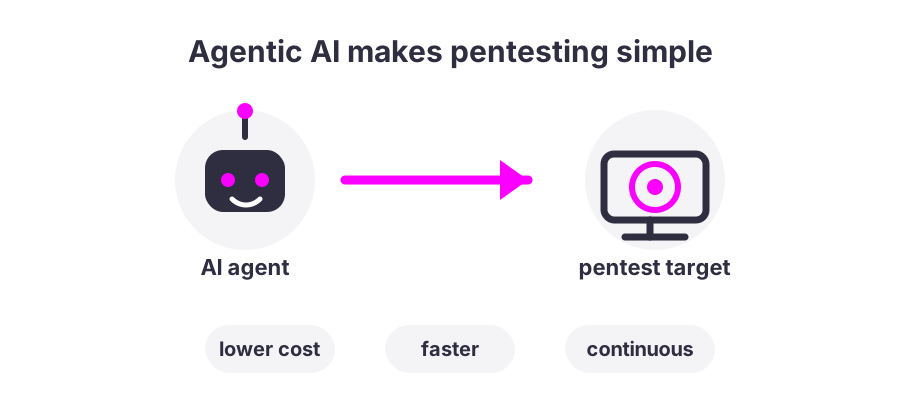
For years, that model looked like this:
- Scan frequently
- Pen test rarely; at most quarterly, but mostly annually or less
That made sense when software changed slowly, and attackers needed time to act on a new or, for that matter, old weakness. The threat environment was also much different from today, and the barrier to entry for threat actors was far higher.
Neither condition holds today. Software ships daily, and script kiddies can exploit a new weakness within days, whereas experienced hackers and nation-state adversaries discover and take advantage of zero days long before defenders become aware of them.
What broke the old model open was progress in artificial intelligence and automation, agentic AI above all. And as much as it has served attackers well, this genuine evolution also made it possible to run authentic penetration testing — the kind that validates exploitability and chains weaknesses into attack paths — and run it continuously instead of once a year.
These developments have become the foundation of the wider practice that Gartner calls continuous offensive security testing (COST): Probe your own systems the way an attacker would, every time your environment changes or whenever you genuinely need to, instead of on a set date on the calendar. The same developments are also what now let PTaaS vendors call their delivery model continuous.
But AI penetration testing is where the capability fully lands. AI-driven platforms do what no team of penetration testers feasibly can: Probe your systems continually, adapting to changes in your environment, finding new endpoints as they appear, and confirming what an attacker could exploit in real time.
The strongest platforms in this category, covered in the 2026 roundup of continuous pen testing tools, are much more than AI-automation on top of old workflows and technologies. They change what security validation means at the speed teams now ship code.
That is where our industry is headed. Organizations needed testing that kept pace with their releases instead of trailing months behind, and continuous AI penetration testing is here to change the status quo.
If your penetration testing is continuous, do you still need a vulnerability scanner?
The answer is not a flat no, though it’s definitely less than you used to.
Vulnerability scanning can still be useful. It is fast, broad, cheap, and good at keeping a running picture of your known exposures.
Instead of “scanner or no scanner,” the question is whether a separate, standalone scanner earns its place once a continuous AI platform is part of your cybersecurity stack. A lightweight scanner’s old selling point that it is cheap and easy to run often matters less when pentesting runs continuously.
That said, two reasons to keep a scanner still hold up well, neither of which is about depth of testing:
- Compliance. Some compliance requirements may mandate specifically vulnerability scanning. For instance, PCI DSS calls for external vulnerability scans every three months by an Approved Scanning Vendor (ASV). A continuous pentest report, however thorough, would not satisfy that specific requirement on its own.
- Existing integrations. Organizations often wire vulnerability management workflows, ticketing in Jira or ServiceNow, and SLA tracking to a scanner’s output. That plumbing takes time to rebuild even when the technical case for change is settled.
And three questions help most teams decide for or against a scanner:
- Does any compliance framework you adhere to require vulnerability scanning as a separate, documented activity? If yes, a scanning activity stays on the books regardless of what else you run.
- Does your continuous platform cover your whole environment? Platforms vary in scope. If yours leaves parts of your infrastructure untested — say internal network hosts or OT systems — a scanner may still earn its place in your tech stack.
- Does your existing tooling feed off scanner output? If your vulnerability management and ticketing depend on it, keep the scanner until a migration makes sense.
If none of these apply, a standalone scanner largely duplicates what a continuous penetration testing platform does.
Equixly: Purpose-built continuous AI penetration testing
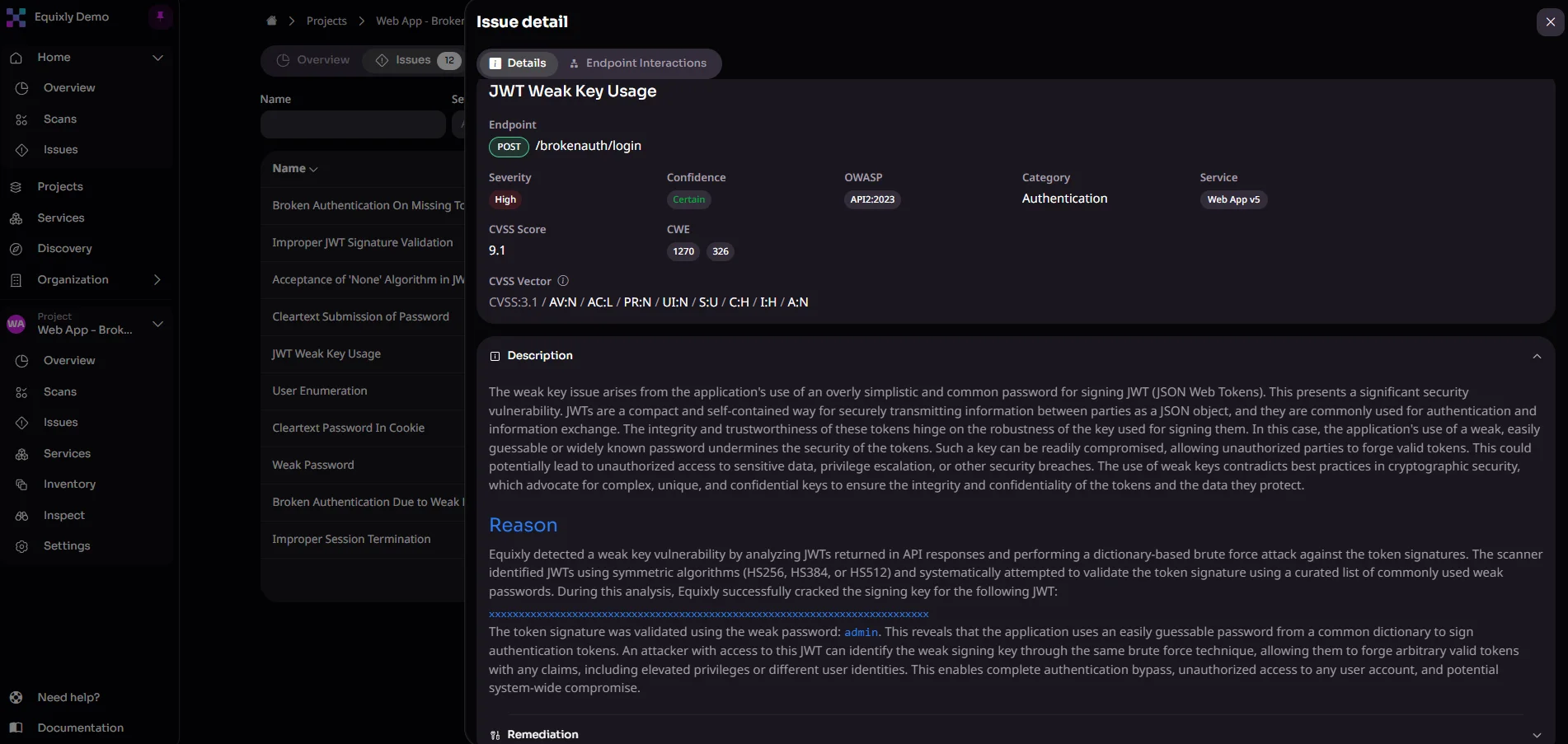
Equixly is not a scanner with AI features bolted on. Continuous autonomous testing is what it was built for from the beginning, and this origin continues to define its identity.
It puts your applications under constant attack, like a real-world adversary, operating as an AI penetration tester that delivers proofs of concept for what can be exploited. It covers the surfaces that carry the most security risk in modern infrastructure:
A proprietary AI system
Equixly runs its own AI system, not a wrapper around a third-party model.
For regulated organizations, this matters a great deal. Your attack surface, your weaknesses, and your exploit paths are among the most sensitive data you hold, and they never pass through an outside model provider. Governance, auditability, and data sovereignty — you keep all in your own hands, which is the difference between a tool you can answer for and one you cannot.
An enterprise-ready solution
Equixly is delivered as SaaS that scales to large, fast-moving environments. It supports the frameworks regulated firms answer to — PCI-DSS, NIS2, PSD2, and ISO 27001 — and integrates easily into CI/CD pipelines, allowing software releases to meet security requirements before shipping.
Banks and financial entities already rely on it, and those are not forgiving environments.
A change-triggered testing model
Testing fires whenever your environment changes, so your security posture keeps pace with development and new exposures. New endpoints get tested as they appear, and, most importantly, findings are validated and accompanied by remediation guidance (rather than guessed at), so your team focuses its time and resources on fixing confirmed security risks.
Go beyond scanning. Validate what’s exploitable.
FAQs
Why isn’t vulnerability scanning enough to prevent breaches?
Vulnerability scanning, also called vulnerability testing, is not sufficient because it can only identify a potential vulnerability. It does not check whether these vulnerabilities are accessible, whether they can actually be exploited, or whether they could harm your operations and/or business.
How does penetration testing add value beyond a vulnerability scan?
Penetration testing is more valuable because it validates whether weaknesses can be exploited. It reveals how an attacker could access the system and what they could do in your specific environment.
Do I still need a vulnerability scanner if I use continuous AI penetration testing?
Yes, in some cases. You may still need scanners for compliance, to fit into existing ticketing workflows, or to cover areas that the continuous testing platform does not address.

Zoran Gorgiev
Technical Content Specialist
Zoran is a technical content specialist with SEO mastery and practical cybersecurity and web technologies knowledge. He has rich international experience in content and product marketing, helping both small companies and large corporations implement effective content strategies and attain their marketing objectives. He applies his philosophical background to his writing to create intellectually stimulating content. Zoran is an avid learner who believes in continuous learning and never-ending skill polishing.

Gavin Sutton
Head of Marketing
Gavin is marketing leader with more than a decade of experience in the cybersecurity industry helping startups and scale ups grow internationally. He has a passion for working with disruptive technology companies who can reshape the security landscape with their innovative solutions.