

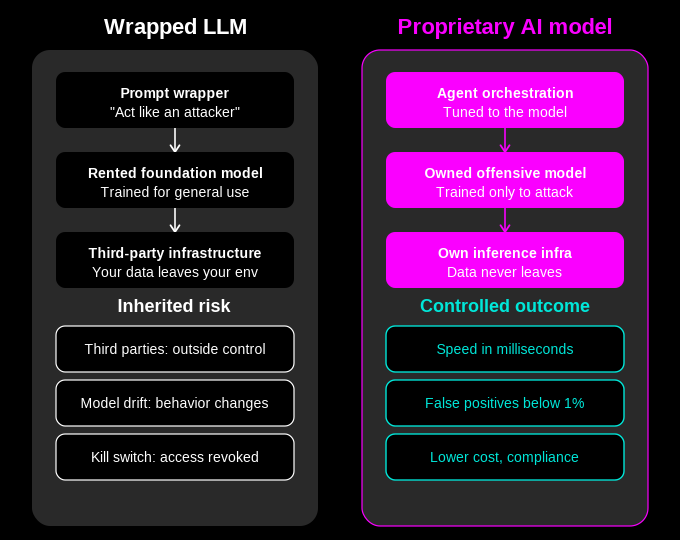
Many tools marketed as AI-powered penetration testing platforms share a common pattern: Pop the hood, and you find the same general-purpose model that powers a chatbot or a coding assistant. GPT, Claude, Gemini: It doesn’t matter that much. The vendor wraps the model in clever prompts that tell it to behave like a security researcher, then ships it as an autonomous pentester.
That works up to a point. The problem is that the model was trained for a different job. Everything in its training pushes it toward producing helpful, accurate text, not toward breaking into systems. The attacker-like behavior comes from the prompt wrapped around it, not from the model itself. Take away the prompt, and the security researcher disappears; what remains is a general-purpose assistant.
And that general-purpose assistant isn’t even yours to rely on. Wrapping your security around an external model means inheriting risks you don’t control:
- Third parties: The capability sits in someone else’s model, not your own stack, so its availability and behavior are outside your hands.
- Model drift: A provider update or retrain can change behavior beneath a wrapper tuned to a prior version, degrading the tool.
- Kill switch: The provider can revoke access. Anthropic’s suspension of Fable 5 under an export control directive shows how a model your tool depends on can be killed overnight.
Equixly took a different road. It purpose-built its proprietary AI for one purpose, and one purpose only: to attack the way a real adversary would. Here is what that means and why it matters for offensive security.
What proprietary AI means at Equixly
At Equixly, proprietary AI means a model the vendor owns and trains itself. Not a rented foundation model in a costume.
Equixly’s Agentic AI Hacker learned its trade from offensive security work and nothing else:
- Attack patterns and exploit chains
- Authorization failure modes
- Business logic abuse
- API interaction sequences that chain one weakness into the next
A third party’s model can only be steered with prompts. But Equixly owns its model: It starts from a generalistic open-weight model and specializes it to do one thing: Find exploitable risk in your APIs, web applications, LLMs, or MCP servers.
That focus is the heart of Equixly’s proprietary artificial intelligence. The model is the product, not a thin layer of instructions wrapped around someone else’s work.
Why owning both the AI model and its orchestration matters for offensive security testing
When Equixly is pointed at your web apps, APIs, LLM applications, and MCP servers, a team of AI agents probes them the way intruders would, chaining one weakness into the next rather than treating each issue in isolation.
Anything Equixly flags, it proves as well. Each finding arrives with working proof-of-concept evidence, framed so an executive sees the business risk and an engineer sees the fix.
A prominent argument in AI security is that the harness matters most: the orchestration of tools, memory, planning, and verification loops around the model. There is truth in that: Good orchestration is real engineering work.
But where another vendor rents the model and builds the harness around it, Equixly owns both; it built them for each other as a single AI solution. Its agents are tuned to a model that already reasons in exploit chains, and every test feeds a proprietary system no competitor can rent, because it exists nowhere else.
You can swap a rented model in an afternoon. You cannot easily reproduce an entire AI system, the model and the orchestration around it, when the two were designed as one.
Why adapting a foundation model underdelivers for offensive security testing
Bolt security reasoning onto a general model, and you hit a ceiling fast. The model’s parameters are geared toward general use, because that is what they were trained for. The “think like an attacker” part is added after the fact, not built into the weights. You end up with an AI tool that is a brilliant generative AI model doing an impression of a hacker. Outstanding, but out of position, like Michael Jordan playing baseball.
This drawback shows up in how the model works. A wrapped model improvises attack paths from general training, not from training built to find them. It still misses the quiet logic flaws that a trained eye catches, like a Broken Object Level Authorization (BOLA) vulnerability that leaks one customer’s data to another.
It also floods you with findings that look plausible and turn out to be noise. A prompt can coax better behavior, but it cannot put specialized expertise into weights that were never trained for it.
Why don’t more platforms do this?
Because building proprietary models is hard, slow, and expensive. It takes
- Offensive security data most companies don’t have
- Training infrastructure most can’t justify
- Specialized talent that’s scarce and costly
Renting a general-purpose model and dressing it in prompts is faster and good enough to demo. That’s why most AI pentesting tools take that route.
None of this is the customer’s problem to solve. No security team should be training its own offensive model; that’s not their business, and the cost would be indefensible. The question is only which kind of model a vendor puts at the center of the product.
Equixly chose to pay the higher cost upfront. Build and own the model, so the customer gets the precision of a purpose-built system without ever touching the AI development, the data pipelines, or the GPU bill behind it.
How Equixly’s AI model works
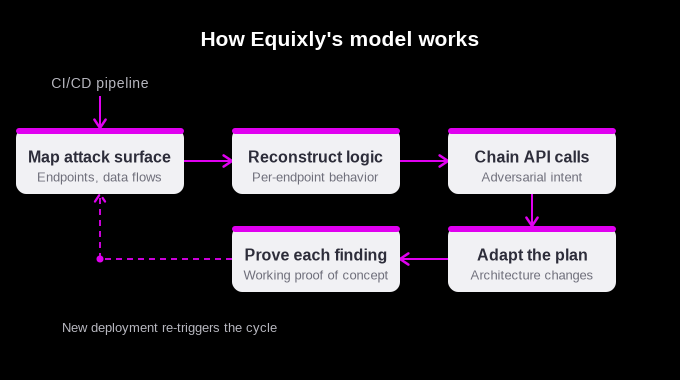
Here is what that purpose-built model does once it connects to your systems and your CI/CD pipeline. It starts by mapping your attack surface, cataloging your endpoints, surfacing shadow assets, and flagging where sensitive data flows. Only then does it go to work, analyzing how your software behaves. It
- Reconstructs the logic of each endpoint
- Chains API calls with adversarial intent
- Adapts its plan as your architecture changes
The AI platform does not wait for a scheduled test. When a new deployment goes live or your environment changes, the AI system probes that change promptly. The result is continuous coverage, not scheduled snapshots.
What Equixly’s proprietary AI model delivers
Performance gains come from specialization. A model with one job runs leaner and sharper than one pulled in multiple directions. Three outcomes are particularly noteworthy:
- Speed. Because the model is lean and purpose-built rather than a large general-purpose system, it returns answers in milliseconds rather than seconds. At the scale of continuous testing, that compounds into thousands of extra checks a general model cannot match in the same window.
- Accuracy. A model whose entire training is focused on an adversarial approach to finding exploitable risk discovers more of it than one that was not. And because it knows what it is looking for, false positives stay low, below 1% across Equixly’s customer testing. Engineers chase genuine problems, not phantom ones.
- Cost. A model specialized for one job can be much smaller than a general-purpose one and still beat it on that job. Smaller model, fewer GPU-seconds per check, lower cost at the scale continuous testing demands. You’re not paying to host reasoning about poetry and Python tutorials you’ll never use.
How Equixly’s proprietary AI model handles data and compliance
Owning the offensive security model carries a benefit that matters as much as the findings themselves.
Equixly runs its AI on its own inference infrastructure. That means your API traffic, endpoints, and results never leave Equixly’s environment. No third-party foundation model vendor sees your data.
For a bank, an insurer, or a healthcare provider (as well as other verticals), this control is not simply a nice-to-have. In enterprise AI, where sensitive data and strict regulation collide, it is often essential to meeting their compliance obligations.
Regulatory frameworks such as PCI-DSS, HIPAA, and SOC 2 demand that sensitive data stays within defined boundaries, and the EU AI Act adds governance and accountability obligations for the AI systems that process it. A platform built on a rented foundation model struggles to make these promises, because the model at its center belongs to someone else.
But what about a capable security foundation model like Mythos?
It’s a fair question. Mythos is a powerful foundation model with security capabilities, so why use Equixly instead? Three reasons: cost, speed, and context.
Using a model like Mythos means sending every test to a third party and paying by the token, which is precisely what makes continuous testing prohibitive. Equixly depends on no third party and no per-token bill.
On speed, Equixly’s smaller model sustains over 6,000 tokens per second, whereas a thorough run against a large frontier model is measured in hours.
Then there’s context. Finding web and API vulnerabilities rarely calls for a frontier reasoning model. Most of these issues are well understood and have been for years, and catching them takes a model trained to look for exactly them, not a general-purpose engine priced for much harder problems.
Pointing Mythos at routine web vulnerabilities is an expensive way to find what a specialized model catches for a fraction of the cost.
Why a proprietary model wins at offensive security
A general model can be told to think like an attacker. Equixly’s model knows nothing else. The first improvises offense from borrowed training. The second holds it in its weights.
- Speed measured in milliseconds
- Accuracy, with false positives below 1%
- Data that stays inside a single, owned environment
- Cost that goes entirely to the one job you need done
All these trace back to a single decision: a purpose-built proprietary AI model. And your security team reads that focus in every report.
See what an AI platform built solely to attack can find across your apps, APIs, and AI systems.
Start a pentest with Equixly.