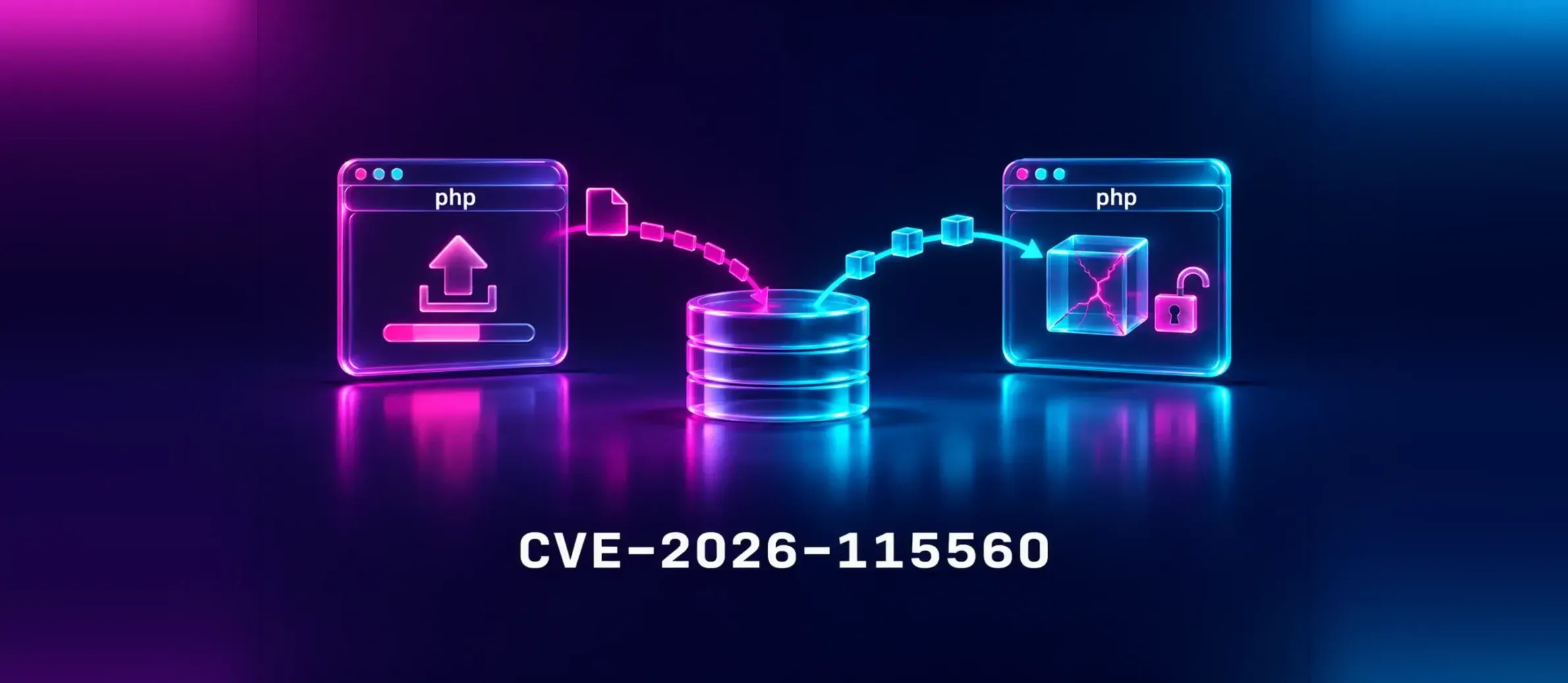

CVE-2026-115560 lets an unauthenticated attacker run code on PHP servers through session upload progress, a feature that was on by default. The attack works wherever applications that share a session store use different session serializers. That reaches further than PHP’s October description, which covered only applications that switch serializers at runtime. PHP fixed the flaw on November 19, 2026, in 8.5.13, 8.4.28, 8.3.37, and 8.2.36, and the fix is also in PHP 8.6.0, released the same day. The security release, rated critical, came four weeks after the PHP2Shell emergency release.
PHP’s October notice named one setup: an application that sets session.serialize_handler to php_binary or php_serialize in its configuration and switches it to php at runtime. According to PHP, applications that never change the serializer at runtime could keep upload progress enabled. The final advisory published with the release widens the conditions: a runtime switch is not required, and an application that never changes its serializer can still be affected when another application or process writes to the same session store in a different format.
The releases also fix other CVEs: 17 in 8.5.13 and between 11 and 13 in the older branches. They include further flaws whose ChangeLog titles name remote code execution (three in 8.5.13, two in the older branches), as well as a request smuggling flaw that its advisory says can let an unauthenticated attacker run PHP code in PHP-FPM under specific front-end conditions. The fix for CVE-2026-115560 changes PHP’s defaults, which teams should test before they roll it out.
Note: we wrote this article on November 19, 2026, the day of the release.
Vulnerability details
TL;DR
- CVE-2026-115560 lets an unauthenticated attacker plant crafted data in a PHP session through the upload progress feature. When the same session is later read with a different serializer, PHP unserializes the attacker’s bytes, which can lead to remote code execution.
- PHP’s October notice tied the flaw to applications that switch their serializer at runtime. The final advisory says a switch is not required: two applications or workers with different serializers sharing one session store are enough.
- Upgrade to the fixed release for your branch: 8.5.13, 8.4.28, 8.3.37, or 8.2.36. PHP 8.6.0 also includes the fix. Until then, set
session.upload_progress.enabled=0in every configuration that writes to a shared session store, or separate the stores. - The fix disables upload progress by default and rejects runtime changes to session settings while it is enabled. Test applications that rely on upload progress bars or change session settings with
ini_set(). - The same releases fix more flaws whose ChangeLog titles name remote code execution (three in 8.5.13, two in the older branches), plus request smuggling and local privilege escalation flaws in PHP-FPM. According to its advisory, the request smuggling flaw can also lead to code execution in PHP-FPM. Upgrade even if CVE-2026-115560 does not apply to you.
What is CVE-2026-115560?
CVE-2026-115560 is a mismatch between how PHP writes session data during a file upload and how it later reads it. According to the PHP advisory, the upload progress feature can write attacker-controlled data in one session serialization format, and a later request can read the same session in another.
PHP ships three built-in session serializers. php_binary and php_serialize store data in formats that the third, php, does not parse the same way. When upload progress is on, a multipart upload that includes a PHP_SESSION_UPLOAD_PROGRESS field makes PHP write a progress record into the session, and that record contains values the attacker chooses, such as the uploaded file’s name.
A public proof of concept published before the fix describes what happens next. The php serializer splits records on the | character, so a | inside the attacker’s file name moves the start of parsing into bytes the attacker wrote. PHP then unserializes those bytes, which can create objects of any class the application can autoload. Whether that becomes code execution depends on what those classes do when PHP destroys or wakes them, the same condition as any PHP object injection.
The proof of concept reached command execution as the web server user against PHP 8.5.12 in a lab built for the purpose, using a cache class, written for the lab, that writes a file in its destructor. Its authors report 15 successful runs out of 15. With PHP’s default session.upload_progress.cleanup=1, which erases the progress record when the upload ends, the attack needed a second request racing the upload, and the authors tested that race only on a local network. They do not claim a working chain against any framework out of the box.
The PHP advisory reports more. The vulnerability report includes command execution using a Guzzle object gadget on PHP 8.2.35, 8.3.36, 8.4.27, and 8.5.12, and command execution was also reproduced with a Monolog 2.11.1 gadget, using a php_serialize writer and a php reader. According to the advisory, exploitability still depends on the shared session configuration, access to the writing and reading paths, and the classes available to the application that reads the session.
Who is affected by CVE-2026-115560?
An installation is exposed when all three of these hold, according to the advisory:
- Session upload progress is enabled, which it was by default before this release.
- An attacker can send a multipart upload to a context whose session serializer is
php_binaryorphp_serialize. - A later or concurrent operation reads the same stored session, with the same session ID, using the
phpserializer.
The October notice described one way to meet those conditions: an application configured with php_binary or php_serialize that calls ini_set('session.serialize_handler', 'php') before session_start(). The final advisory adds a second one. An application that never changes its serializer can still be affected if another application or process writes incompatible data into the same session store. Workers that all use the same serializer do not create the mismatch.
Shared session stores are a normal part of many deployments. Several PHP applications on one host can keep the default session.save_path, and several PHP-FPM pools or containers can point at the same Redis or Memcached instance. If any of them sets a different session.serialize_handler, checking only for a runtime ini_set() call, as the October notice suggested, does not settle exposure.
Installations are not affected when any of these holds:
- Every application and worker that writes to a given session store uses the same serializer, with no runtime changes.
session.upload_progress.enabledis set to 0 in every configuration that can write to the store.- PHP is upgraded to 8.6.0, 8.5.13, 8.4.28, 8.3.37, or 8.2.36, every PHP process has been restarted, and no configuration explicitly enables upload progress.
What else does the November 19 PHP release fix?
The 8.5.13 ChangeLog lists 17 CVEs besides CVE-2026-115560. The table uses PHP’s own description of each flaw and the severity PHP gives it in its advisory, and groups the flaws by the impact their ChangeLog titles name, starting with remote code execution. The older branches get fewer of these fixes: 13 in 8.4.28, 12 in 8.3.37, and 11 in 8.2.36, so check the ChangeLog section for your branch.
CVE-2026-126714, a second remote code execution flaw in the session extension, involves partially overwritten session files. According to its advisory, GHSA-fm2m-fjf5-v3cp, it affects the files session handler, PHP’s default, and requires attacker influence over the session data, an interruption at a useful point in the write, and an application with a suitable deserialization gadget chain.
The PHP-FPM request smuggling flaw can let an unauthenticated attacker run PHP code in the worker, according to its advisory, GHSA-qc49-hpvq-g2w6. Exploitation requires a front end that reuses backend connections, such as nginx with fastcgi_keep_conn on or Apache mod_proxy_fcgi with enablereuse=on, and an application path that opens php://input without reading it to the end. Teams that conclude CVE-2026-115560 does not apply to them still need this release.
“Memory corruption” in the table marks flaws whose ChangeLog title names the bug class but not an impact. Their severity varies: PHP rates CVE-2026-129182 and CVE-2026-129481 critical, and the other three medium.
Which PHP versions fix CVE-2026-115560?
PHP 8.6.0 is a new feature release. The PHP advisory lists only the four security releases as patched, but the 8.6.0 ChangeLog includes the same fix.
PHP 8.1 and older no longer receive fixes from the PHP project, and session upload progress has existed since PHP 5.4. Unless a distribution or LTS vendor backports the fix, set session.upload_progress.enabled=0 on those versions and plan the move to a supported branch.
What changes when you upgrade?
According to the advisory, the fix does two things beyond closing the mismatch:
- It disables session upload progress by default.
- It rejects runtime changes to session settings, including
session.serialize_handler, while upload progress is enabled.
Applications that do not use PHP’s built-in upload progress tracking will not notice the first change. Applications that use it (for example, to drive an upload progress bar from the session) will stop receiving progress data until upload progress is turned back on in the configuration, unless their configuration already enables it explicitly. According to the advisory, an explicit setting overrides the new default.
The second change matters for applications where upload progress stays on or is turned back on. Code that calls ini_set() on session settings before session_start() will then have those calls rejected. Test both paths in staging before rolling the release out, and do not turn upload progress back on in a session store that applications with different serializers share.
Which actions should security teams take?
1. Upgrade and restart
Install 8.5.13, 8.4.28, 8.3.37, or 8.2.36 (or 8.6.0 on the new 8.6 branch), or your distribution’s package that carries the same fixes, then restart PHP-FPM, Apache with mod_php, or whatever serves PHP. A new package on disk does not change workers that are already running.
Then check for configuration that explicitly enables upload progress. According to the advisory, an explicit setting overrides the new default, and the fix does not enforce matching serializers across separate configurations, so every reader and writer of a store where upload progress stays enabled must still use the same session.serialize_handler.
Confirm the version that handles web requests, not only the CLI. php -v reports the command-line binary, which can differ from the one PHP-FPM or mod_php runs, and distribution packages often carry backported fixes under an older upstream version number. We described these traps in more detail for PHP2Shell. For packages, search the changelog for CVE-2026-115560.
2. Reduce exposure until you can patch
Turn upload progress off wherever a session store is shared:
session.upload_progress.enabled = 0Apply it in php.ini, the PHP-FPM pool configuration, or the server configuration, then restart every worker. In its October 21 advisory, PHP warned against relying on ini_set() or FPM .user.ini files for this setting, because they take effect too late. If you set it in October for PHP2Shell, keep it.
If an application needs upload progress, PHP’s advisory gives the alternative: isolate its session storage from applications that use a different serializer, for example, with a separate session.save_path directory or a separate Redis database.
3. Find exposed instances
Exposure depends on configuration across every application that shares a session store, so the check is an inventory of session settings, not a code search in one repository:
- For each PHP-FPM pool, Apache virtual host, and container, record
session.save_handler,session.save_path,session.serialize_handler, andsession.upload_progress.enabled, as the web SAPI reports them throughphpinfo()or a status script. The CLI value can differ, and the advisory names command-line processes as one source of the mismatch, so include command-line jobs that read or write the same session store. - Group them by session store. Any store written by contexts with different
session.serialize_handlervalues, while one of them has upload progress enabled, matches the advisory’s conditions. - Search application code for runtime changes, such as
ini_set('session.serialize_handler', which match the narrower October description. - Include hosting control panels, appliances, and vendor products that bundle PHP and may share a session directory with your own applications.
No indicators of compromise have been published. The proof-of-concept authors suggest watching for multipart POST requests that carry a PHP_SESSION_UPLOAD_PROGRESS field followed within seconds by another request with the same session cookie, for session files that do not decode under the configured serializer, and for PHP files in the web root that your deployment did not create. The field name is configurable through session.upload_progress.name, so match on your configured value.
Timeline
Why configuration decides exposure
Session upload progress has now appeared in two PHP security advisories in a month. PHP listed turning it off as a mitigation for CVE-2026-109619 on October 21, recommended the same for CVE-2026-115560 two days later, and has now turned it off by default. Because it was on by default, it was enabled in installations that never used it.
The two advisories for CVE-2026-115560 also differ in scope. The October notice described the conditions an application would meet on its own, and the final advisory added conditions that come from how applications are deployed together. A team that checked only its own repository in October could have concluded it was safe while sharing a session directory with an application that uses a different serializer. Treat the conditions in an interim advisory as a lower bound until the full advisory is out.
The pattern is familiar from CVE-2026-87902 in WordPress, where register_argc_argv and the presence of PEAR decided whether a file inclusion flaw could reach code execution. A version number says whether a server may be vulnerable. Configuration across everything that shares its resources decides whether an attacker can exploit it.
How Equixly helps
Exposure to CVE-2026-115560 turns on two questions: which PHP applications accept multipart uploads from the internet, and which of them share a session store. Equixly maps the web applications and APIs that attackers can reach and records how each endpoint behaves, including which ones accept file uploads, so you can match reachable upload endpoints against your inventory of session settings and patch those first. For applications reachable only from your internal network, Equixly runs its tests through Space Link, a container you deploy inside that network.
After you upgrade, the same testing shows whether those endpoints still behave as expected, including upload flows affected by the new default. For the difference between a version match and a confirmed exposure, see Penetration testing vs. vulnerability scanning.
Book a demo to see how Equixly maps your exposed applications and APIs and tests them after you patch.