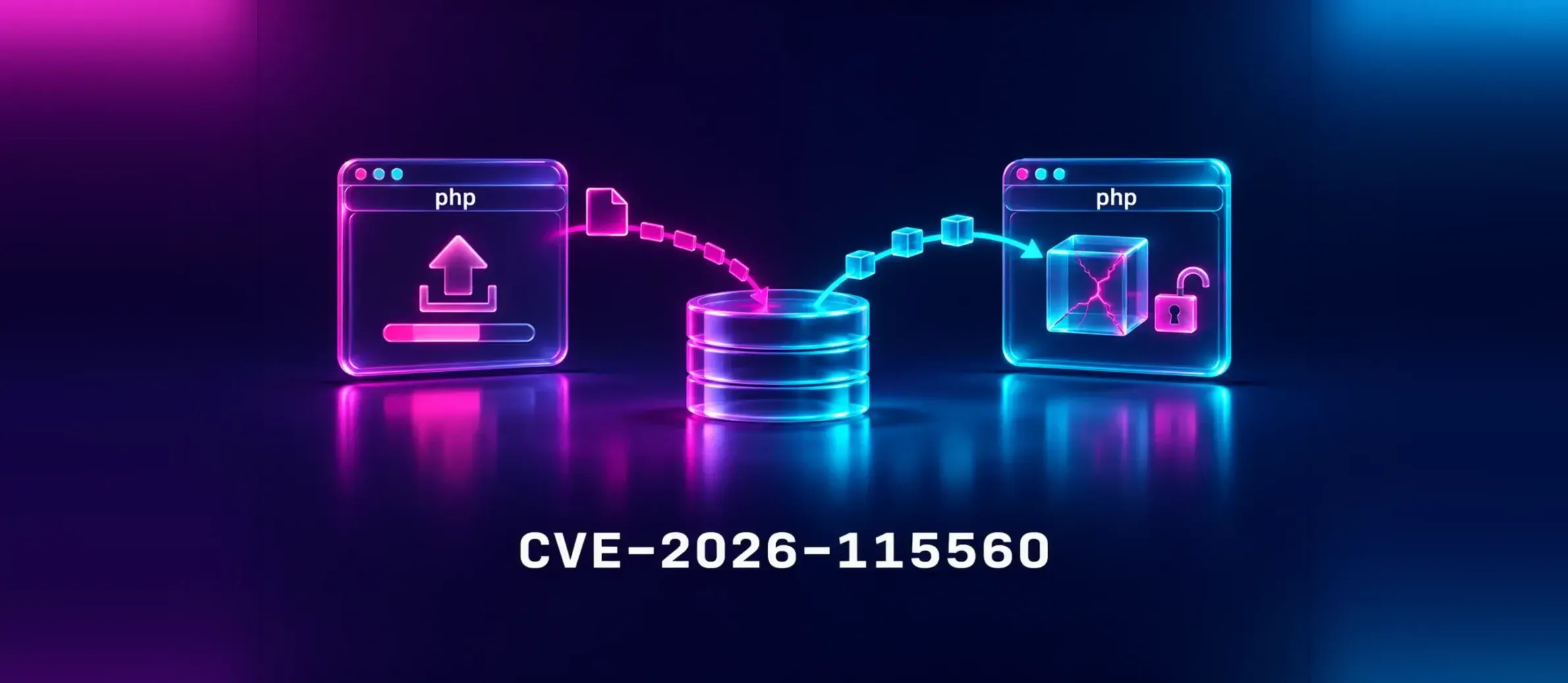

The PHP security team has announced two critical vulnerabilities in PHP, each rated 9.2 on the CVSS v4.0 scale, and scheduled an emergency security release for October 21, 2026, at 14:00 UTC. Security vendors and CERT-EU track them as CVE-2026-109618 and CVE-2026-109619 and report that both allow remote code execution. Researchers call the pair PHP2Shell.
Information about the vulnerabilities leaked on October 20, before a fix existed. Because they sit in PHP itself, they affect every application that runs on a vulnerable PHP build, including WordPress, Drupal, Magento, and Laravel sites. No change to application code can fix them.
Note: We wrote this article before PHP published its advisory.
What are CVE-2026-109618 and CVE-2026-109619?
CVE-2026-109618 and CVE-2026-109619 are two vulnerabilities in PHP that, according to security vendors, allow remote code execution. According to Tenable, attackers could achieve code execution by chaining CVE-2026-109618 with another PHP vulnerability. Researchers at the security firm Calif named this chain php2shell.
How did PHP2Shell become public before the patch?
Details about PHP2Shell leaked nearly two days before the planned coordinated disclosure. watchTowr says the embargo would have ended on Thursday, October 22. After the leak, PHP moved its release forward by a day.
Which PHP versions do CVE-2026-109618 and CVE-2026-109619 affect?
PHP has not published the affected versions yet. watchTowr and CERT-EU repeat a report that every version from PHP 5 onward is affected. Sansec cites a leaked screenshot of an exploit tool named PHP2Shell, whose banner claims the tool works against PHP 5.4.0 and later. PHP has confirmed neither claim.
Unless the PHP team makes an exception, the fix will reach only PHP’s four supported branches. Trackers such as Alpine Linux expect the next point release in each:
PHP 8.1 and older versions no longer receive security fixes from PHP. If PHP2Shell affects them, they will stay vulnerable unless you upgrade to a supported branch or your Linux distribution backports the fix to the version it ships.
What is confirmed about PHP2Shell, and what is still unverified?
PHP has confirmed only that two critical vulnerabilities exist and when it will release the fix. PHP says it will publish the affected component, the affected versions, and the fixed versions with the release. Every other claim comes from the leak, from security vendors, or from researchers who rebuilt the vulnerabilities from partial information.
Reports on exploitation in the wild conflict. Patchstack reported active exploitation on the morning of October 21 but has published no details. watchTowr lists no reported exploitation, and neither CVE appears in CISA’s Known Exploited Vulnerabilities catalog.
Does disabling session.upload_progress mitigate PHP2Shell?
Not on its own. PHP has not published a workaround, and PHP core developer Gina Peter Banyard stated on Mastodon that patching or upgrading PHP is the only mitigation. Even Patchstack, which lists the setting as a stopgap, calls it a partial mitigation that does not stop exploitation.
The workaround traces back to an independent researcher who published an analysis on October 21, before the release, claiming to reproduce both CVEs. The analysis describes two use-after-free vulnerabilities in PHP’s session upload progress handler, and its author later linked a proof of concept.
Several researchers objected that publishing it broke the disclosure timeline. The author replied that someone would publish the details anyway and that defenders gain time by studying them early.
Other researchers question whether the analysis is correct. Security researcher Kostas tested the proof of concept and reported that it failed. An audit posted to a public exploit database argues that the described vulnerability does not exist in released PHP. We do not link to the analysis.
The analysis still shaped the first wave of advice, which recommended a single php.ini change:
session.upload_progress.enabled = Off
Kostas, who had shared the php.ini change, later updated his advice: upgrade PHP, or take servers exposed to the internet offline until you can. watchTowr also notes that the report it reviewed describes no specific configuration or feature that PHP2Shell requires.
The setting turns off upload progress tracking without blocking uploads, so applying it costs little. Use it as one layer of defense while you prepare to patch, and do not treat it as a substitute for the patch.
What should you do before and after the PHP2Shell patch?
Treat every PHP runtime that the internet can reach as affected until PHP’s advisory says otherwise.
- Inventory every PHP runtime and its update source. Include web servers, containers, staging environments, hosting control panels such as cPanel and Plesk, and appliances or vendor products that ship their own PHP binaries. For each runtime, note whether the fix will come from
php.net, a Linux distribution, a container base image, or a hosting provider. - Isolate unsupported PHP versions. Upgrade PHP 8.1 and older to a supported branch, take the system offline, or restrict access to a VPN. CERT-EU recommends isolating applications exposed to the internet wherever you cannot patch immediately.
- Patch systems exposed to the internet first. Sansec expects mass exploitation to start within 15 minutes of the release.
- Restart PHP and confirm the fix. Restart PHP-FPM or the web server, then check the version that PHP reports for a web request. For distribution packages, search the package changelog for the CVE IDs. The next section explains why
php -valone can give a misleading answer.
If a server exposed to the internet ran an unpatched PHP build after October 20, patch it and check it for signs of compromise.
Why can’t a version check settle your PHP2Shell exposure?
A version number tells you which release a server should run. It does not tell you which PHP binary handles requests, whether a backported fix is present, or what an attacker can reach. Four common situations produce a misleading answer:
- Separate binaries for the CLI and the web server.
php -vreports the CLI binary. PHP-FPM ormod_phpcan run a different version and read a differentphp.inifile. - Backported fixes. Debian, Ubuntu, and Red Hat Enterprise Linux often apply security fixes to older upstream versions. A patched package can report an upstream version number that looks vulnerable.
- Bundled runtimes. Appliances, control panels, and vendor products often ship their own PHP build, which a package inventory of your servers does not list.
- Stale processes. A server can have the patched package installed and still serve requests with the old code until PHP-FPM restarts.
Configuration also changes the impact of a PHP vulnerability. In our analysis of CVE-2026-87902 in WordPress, the register_argc_argv setting and the presence of PEAR decided whether a file inclusion vulnerability could escalate to remote code execution.
PHP has not yet published the preconditions for PHP2Shell. Until it does, a matching version tells you that a server may be vulnerable, not that an attacker can exploit it. For more on this distinction, see Penetration testing vs. vulnerability scanning.
What can security testing do before PHP publishes the details?
Security testing cannot check for PHP2Shell directly until PHP publishes the technical details. But it can show which of your applications attackers can reach, so you know where to patch first. Once the details are public, it can also validate whether the patch works.
- Map what attackers can reach. Equixly’s automated discovery interacts with each endpoint of your web applications and APIs to record what it exposes and how it behaves. Combined with your PHP inventory, that map shows which runtimes to patch first.
- Cover internal applications. For applications that only your internal network can reach, Equixly runs its tests through the Space Link agent, a container you deploy inside that network.
- Test the vulnerable path. When PHP discloses the vulnerable code path, security testing can check whether it is reachable in your deployment and whether the fixed version blocks it.
How can you detect PHP2Shell exploitation attempts?
No vendor or researcher has published indicators of compromise for PHP2Shell yet. Until someone does, watch for the process activity that Huntress associates with PHP intrusions. None of these signs proves compromise on its own:
- PHP processes that start other programs. Alert when
php-fpm,php-cgi,httpd, orapache2launches a shell (sh,bash,cmd.exe,powershell.exe), an interpreter (python,perl), or a download tool (curl,wget,nc,certutil.exe). - Reconnaissance from the web server account. Look for commands such as
whoami,id, oruname -arunning under the account that serves web requests. - Unexpected files and persistence. Look for unfamiliar PHP files and webshells in the web root, and for new cron jobs, scheduled tasks, and accounts.
For Linux servers without endpoint detection, Huntress also recommends Florian Roth’s free process-watcher. For Windows, a Sigma rule flags inline command execution by PHP. Record a baseline of normal process activity first, because both can produce false positives.
If you confirm exploitation, isolate the server first. Keep the web server and PHP logs, because cleanup can destroy the evidence you need to scope the intrusion.
What PHP2Shell means for your environment
PHP’s release will answer the open questions about affected versions and preconditions. However, it will not tell you which of your runtimes attackers can reach or which ones still serve old code after an update. Those answers come from your inventory and testing, and you can start on them before the release.
Book a demo to see how Equixly maps your exposed applications and APIs and tests them with an adversarial mindset after you patch.