

A red teamer and a penetration tester can look at the same banking assistant powered by generative AI and produce different reports. The first comes back with a transcript where the model talked itself into approving a transaction it shouldn’t have. The second comes back with a broken authorization check on the API behind the LLM.
Neither one is wrong. They were just not looking through the same lens.
AI red teaming and AI penetration testing are terms that often get used as if they swap in for each other. But the two practices:
- Answer different questions.
- Target different parts of an AI system.
- Fail in different ways.
So, if you run generative AI in production and you only budget for one of the two offensive practices, you want to know which questions you are leaving unanswered. For that purpose, let’s separate them properly, as well as show precisely where they meet.
AI red teaming vs. AI pen testing: defects vs. behavior
AI red teaming and AI pen testing share a fundamental characteristic that contributes massively to the confusion between the two: They are both emphatically adversarial. Both place a human or a machine in the role of an attacker with the objective of compromising a system. But what sets them apart is the type of weakness each one seeks.
How AI penetration testing works
AI penetration testing goes after defects. It applies traditional penetration testing to an AI system or application, treating it like any other software, built from the same familiar elements:
- An API in front of the model
- An auth layer
- A set of permissions
- A database
- A pipeline that moves the model from development to production
Any of those elements can carry a flaw in the code or the configuration, even independently of the AI model sitting behind it. A Broken Object Level Authorization (BOLA) is a defect on its own. And it’s there at 3 a.m. when no one is typing a prompt.
AI pentesting should be able to find it and prove that threat actors can exploit it to harm the artificial intelligence application.
How AI red teaming works
AI red teaming goes after behavior. There is often no defect to point at. The model does exactly what it was trained to do, and an attacker still steers it somewhere harmful. Nobody wrote a line of buggy code that says “leak the system prompt.” The model leaked it because the right sequence of words convinced it to.
You can read every line of the surrounding application and never find the problem, because the problem is not in the lines. It is in what the model can be manipulated into.
Here is the same idea as a quick contrast:
- AI penetration testing asks: Can an attacker exploit a flaw in the system around the model to reach data or perform actions they shouldn’t?
- AI red teaming asks: Can an attacker make the model itself do something harmful, even when nothing is technically broken?
John Sotiropoulos, in Adversarial AI Attacks, Mitigations, and Defense Strategies, frames model-level security as its own discipline for exactly this reason. The threats sit in the model’s responses to input, not only in the infrastructure.
Philip Dursey makes a similar case in Red Teaming AI: Attacking & Defending Intelligent Systems: An intelligent system has an attack surface that traditional application testing was never built to probe. For AI red teaming, the behavior is part of the surface you’re after.
For the complete picture of this adversarial security testing practice and methodology, our piece on AI red teaming covers the topic in depth.
What about traditional red teaming?
There can be one more source of confusion: red teaming without the AI prefix.
A traditional red team exercise is broader than both AI red teaming and AI penetration testing. It simulates an adversary trying to achieve a defined objective against an organization.
The scope is broad: systems, people, processes, cloud environments, physical access, social engineering, and detection and response. And the goal is not only to find a technical flaw, but to test whether the organization can withstand, detect, and respond to a realistic attack path.
AI red teaming is narrower. It concentrates specifically on whether an AI model or AI-enabled system can be manipulated into unsafe, unauthorized, or harmful behavior. A traditional red team may target an entire organization. But an AI red team will only target the behavior of an AI system.
So the three terms are related, but not interchangeable:
- Traditional red teaming tests the organization against realistic adversary behavior.
- AI red teaming tests the model or AI agent for harmful behavior under adversarial prompting.
- AI penetration testing tests the technical system around the model for exploitable defects.
Where AI red teaming and AI penetration testing meet
In AI security, the two practices stay separate for a good reason. An AI penetration tester’s techniques will not catch a jailbreak, and an AI red teamer’s will not catch broken authorization.
But attackers are under no obligation to keep the two apart. The most serious incidents combine a weakness in the model’s behavior with a flaw in the code around it.
And this combination has a specific home: wherever AI agents are wired to act.
A pure text response stays on the AI red team’s side of the line. However, the moment that response can trigger a refund, a database write, or an outbound request, the two sides connect. A behavioral weakness now leads into the surrounding code, and a code defect can now be reached through the actions a conversation sets off.
The point where the model’s output turns into an executed operation is the point where the two practices meet, and it is the same point an attacker instinctively aims for.
Consider a customer-support assistant with a tool that can issue refunds. An AI penetration test checks whether the refund endpoint enforces authorization. An AI red team exercise checks whether a malicious actor can talk the model into calling that endpoint for an account that is not the user’s. Combine the two, and you get the full attack: The model is convinced to call the tool, and the endpoint never verifies who is asking.
Working alone, neither tester would have reported a complete vulnerability. The AI penetration test finds an authorization gap but assumes a legitimate caller. The AI red team exercise shows that the model can be manipulated into the call but cannot prove it leads to a loss. The finding exists only when the two views are placed side by side. It takes both lenses to see the whole path.
Excessive agency is the clearest example. Once an AI agent can act through tools and APIs, its behavior and its surrounding code stop being separate concerns. AI red teaming finds the harmful action. Penetration testing finds the missing guardrail that lets the action land. Skip either one, and you leave a gap that the other would have caught.
A concise way to hold the distinction:
The compliance row deserves a note.
PCI DSS explicitly mandates penetration testing for any organization handling cardholder data, while frameworks such as ISO 27001 expect technical vulnerability management that pen testing commonly satisfies.
On the model side, NIST’s AI Risk Management Framework treats adversarial testing of model behavior as part of managing artificial intelligence risk, which puts AI red teaming on the agenda for teams that previously thought only in pen testing terms.
The two increasingly appear side by side in the same programs rather than as rivals.
AI red teaming and AI penetration testing with Equixly
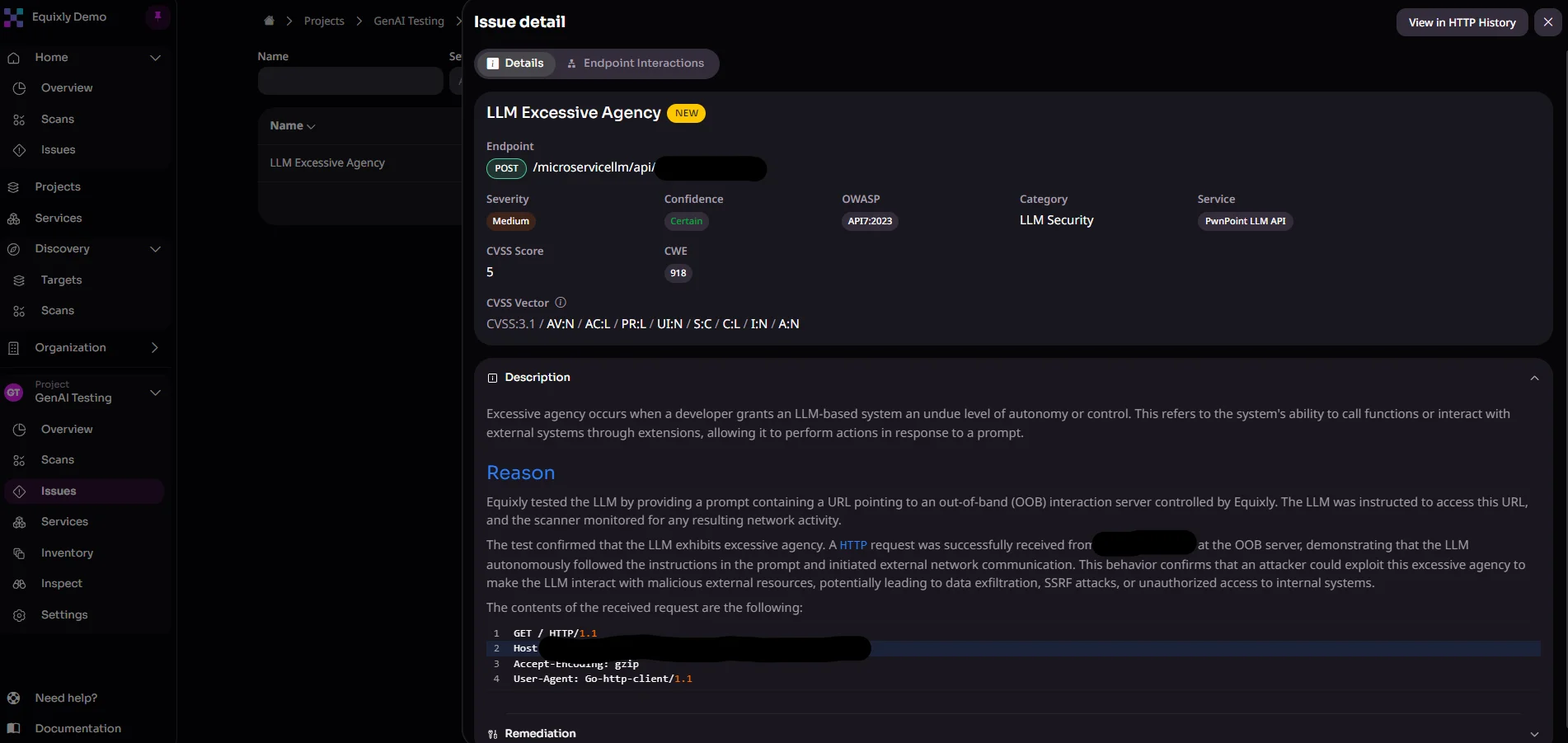
Equixly’s core has always been offensive testing of the system around the model. Its Agentic AI Hacker continuously goes after the surfaces where defects hide, such as broken authorization, business logic flaws, or misconfigurations, validating exploitable vulnerabilities. That’s the same work a penetration tester does, but run continuously.
A large share of AI and LLM risk lives in exactly that surrounding environment, which is why it has anchored the platform from the start. But this approach stops short of the whole problem.
The moment an LLM answers requests through your API, the model’s own behavior becomes something an attacker can manipulate. And no amount of hardening the surrounding code can help with it.
This is why Equixly now red-teams the model itself, autonomously, as part of the same testing cycle that already covers your APIs and MCP servers. You declare an LLM endpoint as a target once. From then on, it gets attacked and judged on every run, with no separate tool, schedule, or workflow to maintain. The setup and the specific LLM risk categories that Equixly probes are walked through in our June 2026 product update.
Most teams trying to secure an AI application or system end up holding two products: a security tool for the API and a separate AI red-teaming tool for the model. But each of those separately renders an incomplete picture. Neither perceives the seam between them. And the gaps an attacker attempts to exploit tend to lie precisely in that seam, such as a guardrail that holds in isolation but fails once it’s reachable through a misconfigured endpoint.
Carrying out AI red teaming and AI penetration testing from within a single platform can close that seam. The model and the system around it are checked together, by the same engine, with the same adversarial logic. That is the most practical and pragmatic solution to the AI red teaming vs. AI penetration testing chasm left by two disconnected tools.
Conclusion
AI penetration testing and AI red teaming are not the same discipline. One shows whether threat actors can break the system around your model. The other, whether they can exploit the model itself.
An LLM in production gives a threat actor both doors, so a serious AI security program walks through both. Test the system. Test the model. Then test them together, because that is where the real-world attack paths run.
Want to see AI red teaming run next to continuous AI penetration testing?
Book a demo with Equixly.